The dish room is the part of the kitchen that owners plan last and staff dread most. It is also the part that quietly limits the whole operation: if clean plates and glasses do not come back fast enough, the line stops, no matter how good the cooking is.
Choosing a machine means two decisions that people often blur together. One is the physical type of machine, which determines how fast it works and how much space it needs. The other is how it sanitizes, with heat or with chemicals, which determines utilities, ventilation and running costs.
In brief
- Washing and sanitizing are separate jobs; sanitizing is by heat or by chemical.
- Size the machine to your busiest hour in racks, with margin.
- Plan the dish room’s one-way flow before you pick the machine.
Wash and sanitize are different jobs
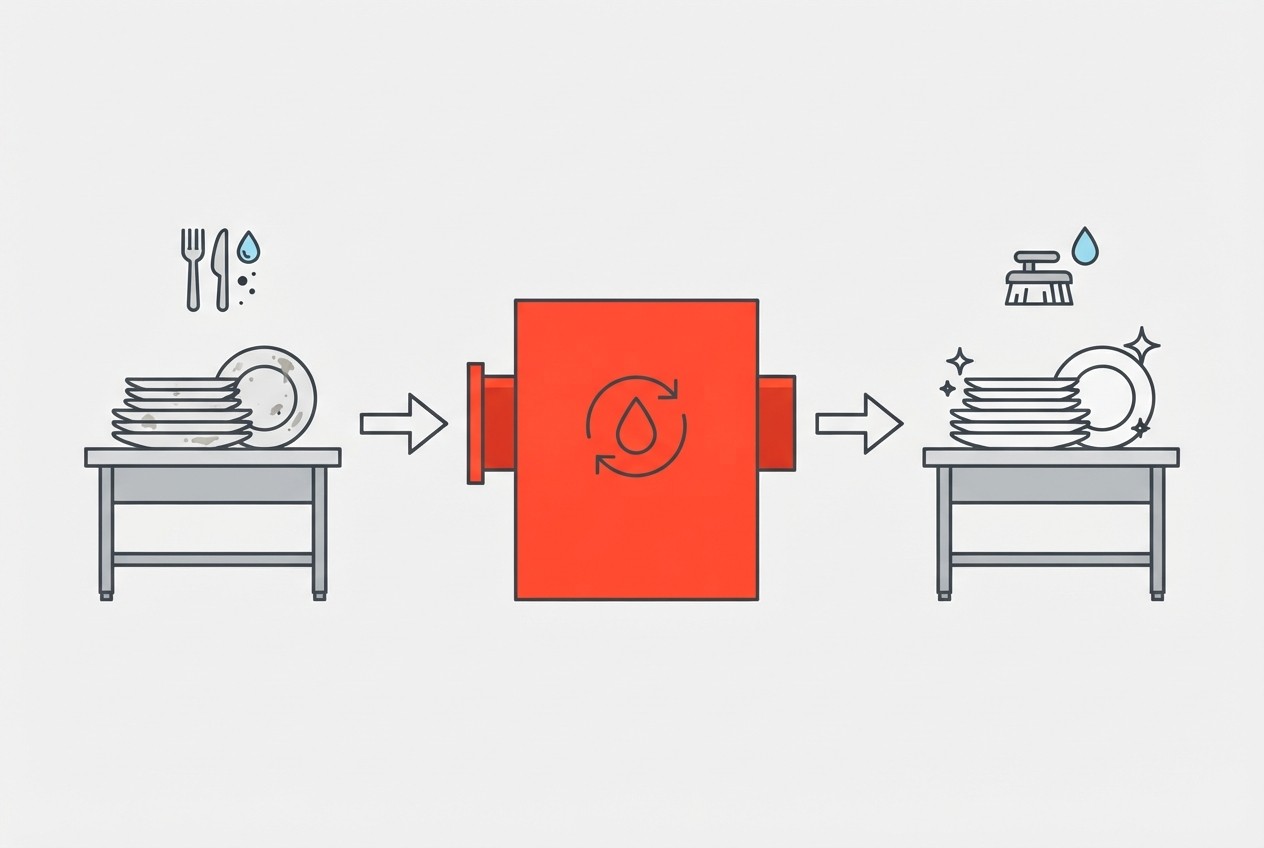
A dish machine does two things in sequence. First it washes: hot water with detergent and mechanical action removes soil. Then it sanitizes: a final step reduces microorganisms on the surface to a safe level, either with very hot water or with a chemical sanitizer in the rinse.
The required sanitizing conditions, including temperatures and chemical concentrations, are set by your health code and by the machine’s own data plate and manufacturer’s instructions. We do not state them here as requirements. Confirm them with your local health authority and your equipment supplier, and verify them in daily operation.
High-temperature versus low-temperature
High-temperature machines sanitize with a final rinse of very hot water. Because ordinary water heaters do not reach that temperature, these machines use a booster heater, either built in or separate, to raise the rinse water. The heat also helps dishes flash-dry in the air.
Low-temperature machines, often called chemical sanitizing machines, run at a lower water temperature and use a chemical sanitizer, commonly a chlorine-based product, injected into the final rinse. They need no booster heater.
| Factor | High-temperature | Low-temperature (chemical) |
|---|---|---|
| How it sanitizes | Very hot final rinse | Chemical sanitizer in the rinse |
| Booster heater needed | Yes | No |
| Electrical demand | Higher, driven by the booster | Lower |
| Drying | Dishes dry quickly from retained heat | Dishes dry more slowly |
| Ongoing supplies | Detergent and rinse aid | Detergent, rinse aid and sanitizer |
| Verification | Check rinse temperature | Check sanitizer concentration with test strips |
| Room impact | More steam; may need ventilation | Less steam; chemical smell possible |
| Main failure | Booster fault, scale on elements | Empty or blocked chemical supply, wrong concentration |
Neither is better in general. High-temperature suits operations that can supply the electrical or gas capacity and ventilation, and that want fast drying and no dependency on chemicals. Low-temperature suits kitchens with limited electrical capacity, and it is common in undercounter machines. In both cases the safety comes from verifying the machine is operating within its stated conditions every day.
The physical types
Undercounter
A compact machine that fits beneath a counter, loaded from the front with a single rack. It suits cafés, small restaurants and bars, where dish volume is modest. Cycle times are longer than larger machines and capacity is limited, so a busy service can overwhelm one. Good for glasses and small ware.
Door-type, also called hood-type or pass-through
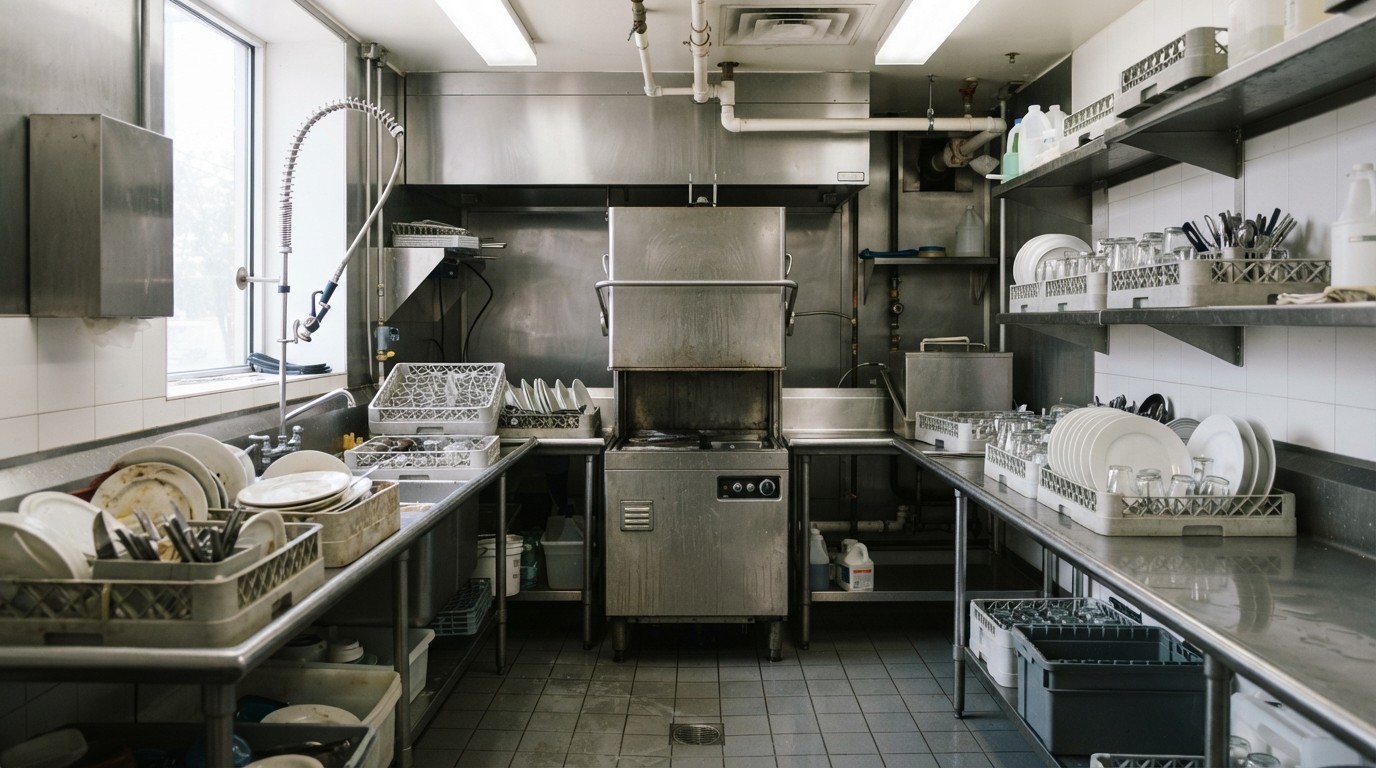
The workhorse of mid-sized restaurants. A rack is slid in, the hood is pulled down, the machine runs, and the clean rack is slid out the other side. It handles substantially more than an undercounter, and its dish table design allows a continuous flow from soiled to clean.
Conveyor and flight-type
Racks or items ride a conveyor through wash and rinse zones continuously. These are for high-volume operations such as large restaurants, hotels, institutions and banquet kitchens. They deliver the highest throughput and take the most floor space, water and utility capacity.
Matching machine to volume
Capacity is usually stated in racks per hour. Estimate your peak, not your average. Count how many plates, glasses and utensils come back in the busiest hour, convert to racks, and add margin. A machine that handles your average load comfortably will fail at peak, and at peak is exactly when you need it.
Remember that the stated figure assumes a continuously fed machine. Real rates fall if the soiled table backs up, the clean table fills, or staff are unfamiliar with the loading routine. A machine is only as quick as the system around it.
Designing the dish room
- One direction of flow. Soiled ware enters one side, passes through the machine and exits clean on the other. The two sides should not touch.
- A scraping and pre-rinse station. Food debris removed and a pre-rinse sprayer before racks are loaded. This keeps the wash water cleaner and the machine working better.
- Enough table length. The soiled table needs room to stack racks before the machine, and the clean table needs room to stack racks after it. Too short and the line backs up.
- A separate path for the dish return. Staff bringing ware from the dining room should not cross the cooking line.
- A pot-washing arrangement. Most health codes require separate provisions for pots and pans, which are too large and awkward for rack machines, commonly a compartment sink. Ask your plan reviewer what is required.
- Storage for clean ware nearby. Shelving and dollies close to the clean end save the longest carry in the dish room.
What the building must supply
Dish machines have particular utility needs: hot water supply of sufficient volume and temperature, drains in the right location, correct electrical connection, and possibly a booster heater. Many also need water of reasonable quality, because hard water leaves scale on elements and spray arms and spots glassware, and some operations install water treatment.
High-temperature machines release steam, which can raise humidity and temperature in the dish room. Ventilation requirements depend on the machine and on local code, and some require a hood or condensate-handling arrangement. These are plumbing, electrical and mechanical works for licensed contractors, with permits and inspections, and they need to be settled with the equipment selection and not afterwards.
Operating habits that decide the outcome
- Train everyone who loads it. Racks, loading orientation and what not to put in the machine make a significant difference to results.
- Check the sanitizing conditions every shift. Rinse temperature for heat machines, or concentration for chemical machines. Use test strips and a thermometer, and write down the result, because your inspector may ask.
- Keep chemical supplies stocked. A machine that runs out of detergent or sanitizer still cycles, which is worse than stopping.
- Clean it daily. Remove and rinse strainers, clear spray arms of debris, drain and clean the tank, and leave doors open overnight to dry.
- De-lime on schedule. Scale on heating elements reduces performance and shortens their life, especially in hard-water areas.
- Set up a service agreement. A dish machine that fails on a Saturday can close a restaurant. A supplier with a service contract and a quick response is worth having before you need one.
Questions before you buy
- What does my health authority require for sanitizing, for pot washing and for the machine’s certification?
- What is my realistic peak load in racks per hour?
- Can my building supply the hot water, drainage and electrical capacity this machine needs?
- Does the machine need a booster heater, and who supplies and installs it?
- What ventilation does it require, and is it approved for my room?
- Who supplies the chemicals, and what does the supplier provide for dispensers, training and testing?
- What is the service response time and warranty?
Dish machines reward being a little oversized and being installed with real thought about flow. A modest saving on the machine is rapidly lost if the room around it forces staff to carry bus tubs the long way round. Plan the room first, then fit the machine to it.
Choosing by operation
- A small cafe with modest volume and limited electrical capacity: an undercounter chemical-sanitizing machine is common. Confirm with your supplier and health authority.
- A mid-sized restaurant with a steady rush: a door-type machine, with a scraping station and tables long enough to stack racks.
- A banquet or high-volume operation: conveyor or flight-type, with the utilities and floor space they need.
- You want fast drying and no dependency on chemicals: heat sanitizing, if the building can supply the booster capacity and ventilation.