Chefs often arrive at the gas-versus-electric question with a strong opinion. Cooks trained on gas usually distrust electric, and a growing number of operators now prefer induction. Both sides are right about something, and neither is right about everything.
The better question for an owner is not which is superior but what each one asks of your building, your ventilation and your cooks. Those answers are practical, and they often decide the matter before taste does.
How the two actually differ
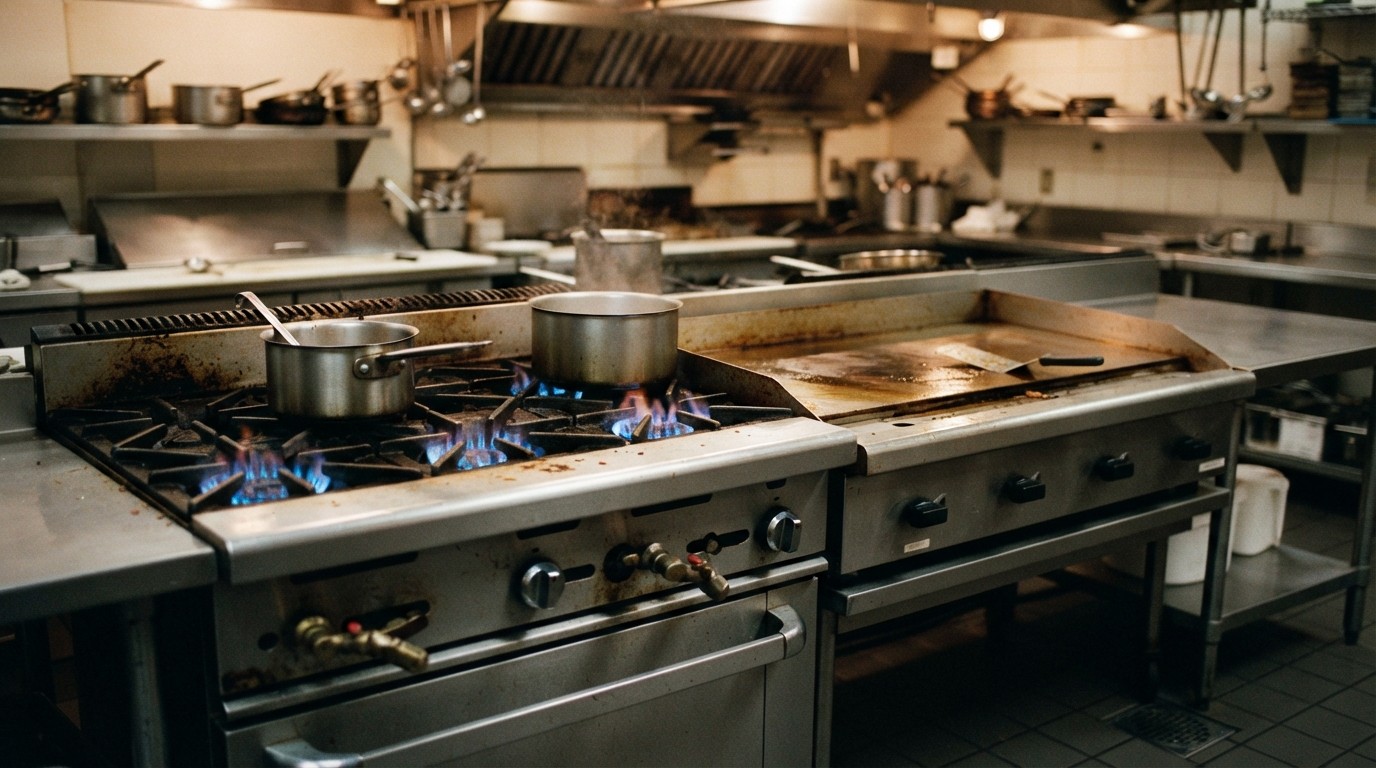
Gas equipment burns natural gas or propane to produce a flame. Heat appears at once, can be seen, and is adjusted by eye. Gas heats the pan or the cooking surface and also a good deal of the air around it, because much of the flame’s output escapes.
Electric equipment uses electrical resistance elements, or in the case of induction, a magnetic field that heats the cookware directly. Heat transfer is more efficient because less is lost to the room, and temperature can be controlled precisely. The trade-off is in how the heat behaves and what supplies it.
What changes at the stove
- Response. Gas responds visibly and instantly to the knob. Induction responds as fast or faster in the pan, with fine control. Traditional electric elements are slower to heat and slower to cool, which cooks notice immediately.
- Heat feel. Gas produces the open-flame feel and lets a cook tilt a pan into the flame. Some tasks, such as wok cooking, are built around the high, concentrated heat that a purpose-made gas burner delivers.
- Recovery. This is how fast equipment returns to temperature after cold product is loaded. It matters most for fryers and griddles during a rush. Both fuels can have excellent recovery in good equipment, and recovery depends more on the unit’s rated input and design than on the fuel.
- Evenness. Electric griddles and flat-tops often hold surface temperatures more evenly, while gas surfaces can show hot spots above burners. Good design narrows the difference.
- Cookware. Induction heats only magnetic cookware. Gas and conventional electric work with nearly anything, so induction can mean replacing pots and pans.
What changes in the kitchen
Heat in the room. Because gas equipment loses more of its output to the air, a gas line makes a kitchen hotter. That raises the load on ventilation, increases the cost of cooling, and affects how long cooks can work comfortably at a station. Operators converting to electric or induction commonly report cooler kitchens, though results depend on the equipment and the design.
Ventilation. Cooking equipment that produces grease-laden vapour requires hood and exhaust systems, and the type of hood and the volume of air depend on the equipment and on local code. A change of fuel does not remove the need for ventilation, though it can change the requirements, and make-up air must replace whatever the hood extracts. These are engineered, permitted systems, so involve a licensed contractor and your local authority from the start.
Combustion byproducts. Burning gas releases combustion products into the kitchen air, which the ventilation system must handle. Induction produces none at the point of use.
Power outages. Many gas appliances still need electricity for ignition, controls or fans, so the assumption that gas keeps working in an outage is often wrong. Check the specification for the equipment you are considering.
What your building has to supply
This is the most decisive factor and the one most often discovered late.
Gas equipment needs a gas supply of adequate size, correct piping to the line, appropriate shutoff and safety controls, and a gas meter that can deliver the demand. An older building, or one that has never had a commercial kitchen, may not have enough capacity, and upgrading service can involve the utility, the landlord and significant lead time.
Electric equipment needs electrical capacity. Commercial cooking equipment can draw a very large load, and much of it is specified for three-phase power rather than the single-phase supply typical of homes and small buildings. If the building does not have the supply, adding it can be costly and slow. Induction is efficient, but the equipment still has to be fed.
In either case the work belongs to licensed contractors, with permits and inspections. Some jurisdictions are also changing rules about new gas connections or about electrification, and rules differ by city and change over time, so ask your building department before committing to a fuel.
Operating costs: ask the right questions
It is tempting to compare per-unit prices for gas and electricity and declare a winner. That comparison is misleading, because the equipment converts energy into useful cooking at different efficiencies, rates differ by region and by time of day, and electricity and gas are priced in different units and often with demand charges that depend on peak consumption.
A more reliable approach is to estimate the real cost for your own kitchen. Ask your utility about commercial rates, including any demand charges. Ask equipment suppliers for the rated energy input and efficiency of the specific models. Ask your ventilation contractor how the choice changes your exhaust and cooling load. We do not quote energy prices here, because they vary too much for a number in an article to be useful.
Gas, electric and induction in practice
| Factor | Gas | Electric and induction |
|---|---|---|
| Heat to the room | Higher | Lower |
| Control feel | Visible flame; instant | Precise; induction very fast |
| Building requirement | Adequate gas service and piping | Adequate electrical capacity, often three-phase |
| Cookware | Anything | Induction needs magnetic cookware |
| Ventilation load | Higher, with combustion products | Lower, still needs grease ventilation for many tasks |
| Cleaning | Burners and grates to clean | Smooth surfaces, easier to wipe |
| Cost picture | Depends on local gas and electricity rates | Depends on local electricity rates and demand charges |
| Outage behaviour | May still need power for controls | Stops |
Choosing equipment by task, not by principle
Many successful kitchens use both. The decision can be made station by station.
- Sauté and sauce. Induction suits the fine control and quick response, and it keeps the station cooler. Gas remains the choice of many cooks who value the flame.
- Wok cooking. Purpose-built gas wok burners remain the standard for the intense heat the technique relies on, though some induction wok units exist.
- Fryers. Both are common. Compare rated input, recovery and the efficiency of the specific models.
- Griddles and flat-tops. Electric units often offer even surface temperature, and gas units offer high output. Compare specifications.
- Ovens. Electric convection ovens are widely used, and gas units are common too. The more important choices are size and control.
- Holding and warming. Almost always electric.
Questions to ask before you commit
- What gas and electrical capacity does the building have, and what does each upgrade involve, in cost and lead time?
- What does my local building department say about gas connections in a new or renovated kitchen?
- How does each choice change the hood and make-up air design, and who is designing it?
- What are my local gas and electricity rates for commercial customers, including demand charges?
- Will my cooks work with the equipment, and what training or cookware changes does it need?
- What does the manufacturer’s rated recovery look like for my highest-volume item?
- What happens to service when the power goes out?
The honest summary is that fuel is a consequence of constraints more often than it is a choice. Start with what the building can supply and what your local authority allows, narrow the options, and then let your cooks and your menu decide among what remains.
Key takeaways
- Fuel is usually decided by what the building can supply and what the building department allows.
- Cooler kitchens and cleaner air are real benefits of induction and electric; cookware and electrical capacity are the costs.
- Choose station by station: wok on gas, saute on induction, holding on electric.
Planning the whole line? Read how to plan a commercial kitchen layout around the flow of food.